The Less-Is-More Glow-Up: Why Celebrities Are Trading Maximalism for Million-Dollar Minimalism
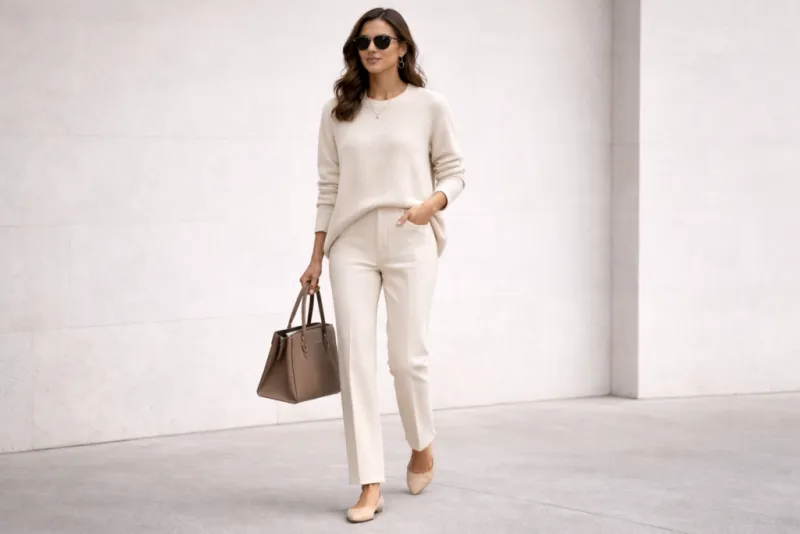
Photo: celebrity minimalist fashion neutral tones elegant simple outfit style, via everydaystylearchive.com
There's something almost rebellious about showing up to a major event in a perfectly cut cream blazer and wide-leg trousers with zero embellishment, zero branding, and zero drama — and somehow commanding every camera in the room. That's the quiet luxury paradox, and it has completely taken over celebrity culture in a way that nobody totally predicted.
Call it stealth wealth. Call it old-money aesthetic. Call it whatever you want — but you cannot scroll through celebrity Instagram feeds, red carpet roundups, or TikTok fashion commentary right now without running straight into it. And the more you look at it, the more it makes a strange kind of sense.
How We Got Here
To understand why stars are suddenly obsessed with looking deliberately understated, it helps to remember where we just came from. The late 2010s and early pandemic era were peak maximalism. Think Cardi B in full-body latex, influencers in neon everything, and red carpets that looked like they were competing for who could fit the most fabric into a single look. Logos were everywhere. Bigger was better. Louder was the point.
And then — gradually, then all at once — the vibe shifted.
Some credit the HBO show Succession with kicking off the mainstream conversation. The Roys dressed in quiet, impeccably tailored pieces that whispered old money so loudly it basically screamed. No logos. No flash. Just fabric quality and cut doing the heavy lifting. Fashion writers started calling it "stealth wealth" and the internet ran with it.
But it wasn't just a TV show. Post-pandemic culture broadly pushed toward a kind of intentional restraint. People were rethinking consumption, questioning excess, and gravitating toward things that felt considered rather than chaotic. Fashion, as it tends to do, picked up on that frequency.
The Celebrities Setting the Tone
Some A-listers have practically become the unofficial faces of this movement.
Sofía Richie Grainge's wedding in 2023 was a masterclass in the aesthetic — all ivory, tailored, and serene in a way that broke the internet despite (or because of) being the opposite of maximalist bridal excess. Her looks have since become reference points that stylists actually cite in client meetings.
Hailey Bieber has been deep in this territory for years, favoring clean silhouettes, neutral palettes, and brands like The Row, Totême, and Khaite that cost a small fortune but look, to an untrained eye, almost plain. Gwyneth Paltrow's courtroom fashion moment became a meme precisely because her ski outfit looked so effortlessly, expensively nothing.
Zendaya, who can do maximalism better than almost anyone, has been deliberately oscillating between high drama and severe minimalism in a way that keeps both modes feeling intentional rather than default. Even Beyoncé's Renaissance tour press looks leaned into sleek, architectural simplicity in ways her earlier eras didn't.
The Brands Quietly Winning
Here's where it gets interesting from a business angle. The labels profiting from quiet luxury aren't necessarily the flashy heritage houses — or at least, not the flashy versions of those houses.
The Row, founded by Mary-Kate and Ashley Olsen, has become the brand most synonymous with the aesthetic. A single cashmere sweater can run $1,500. A coat might be closer to $5,000. There are no logos. The brand barely advertises. And yet it is everywhere right now, on everyone from Kendall Jenner to industry insiders who treat owning a piece like a badge of membership in a very expensive, very quiet club.
Lorenzo Bergamo, a New York-based personal stylist who works with entertainment clients, puts it this way: "My clients used to ask for looks that would photograph dramatically. Now they want to look like they didn't try — but in a way that only works if you spent a lot of money. That's a harder brief than it sounds."
Other brands riding the wave include Totême, Khaite, Lemaire, and even Bottega Veneta, which leaned hard into understated intrecciato leather goods after Daniel Lee's tenure transformed the brand's direction. Quiet luxury has also been a gift to tailoring-focused American labels that had been overshadowed by louder competitors.
Gen Z's Complicated Relationship With the Trend
You might expect Gen Z — a generation that built its aesthetic identity on irony, color, and anti-establishment dressing — to reject quiet luxury as the province of boring rich people. And some of them absolutely have. The "weird girl" aesthetic, maximalist Y2K revival, and thrift-flip culture are all alive and well as counter-movements.
But a significant chunk of Gen Z has genuinely embraced the quieter direction, and their reasons are worth paying attention to. For a generation that grew up watching influencer culture implode under the weight of its own excess and performative consumption, dressing in a way that looks considered and lasting rather than trend-chasing feels almost like a political statement.
There's also a very Gen Z tension at play: the aesthetic is aspirational but also, in its TikTok-ified form, democratized. You don't actually need The Row to pull off quiet luxury. Thrifted blazers, Gap basics, and Uniqlo essentials have become the "budget quiet luxury" staples that rack up millions of views on style content. The idea has filtered all the way down.
What This Actually Says About Us Right Now
Fashion has always been a mirror. And the fact that celebrity culture is currently obsessed with looking expensive in a way that's deliberately invisible to people who don't know what they're looking at says something pretty specific about this moment.
There's an anxiety about visibility baked into quiet luxury. In a world where everything is documented, screenshotted, and dissected, dressing in a way that only registers to insiders feels like a form of privacy. It's a way of being seen by the right people and invisible to everyone else — which, when you think about it, is a fantasy that makes a lot of sense for celebrities specifically.
It also reflects a broader cultural fatigue with the performance of aspiration. After years of influencer culture making excess feel like a personality, the pendulum is swinging toward a different kind of status signal — one that's quieter, more durable, and honestly, a little harder to fake.
Whether the trend has legs beyond the next few seasons is anyone's guess. Fashion moves fast, and the maximalists are always waiting in the wings. But right now, the most interesting thing a celebrity can do at a major event is show up in something that looks like almost nothing — and make everyone in the room wish they knew where it was from.